
Solar geysers work by utilising technologies that harness solar radiation (Either luminosity or IR) to heat up water up to a temperature that is suitable for domestic use.
How do Solar Geysers work?
Solar geysers work by utilising technologies that harness solar radiation (Either luminosity or IR) to heat up water up to a temperature that is suitable for domestic use.
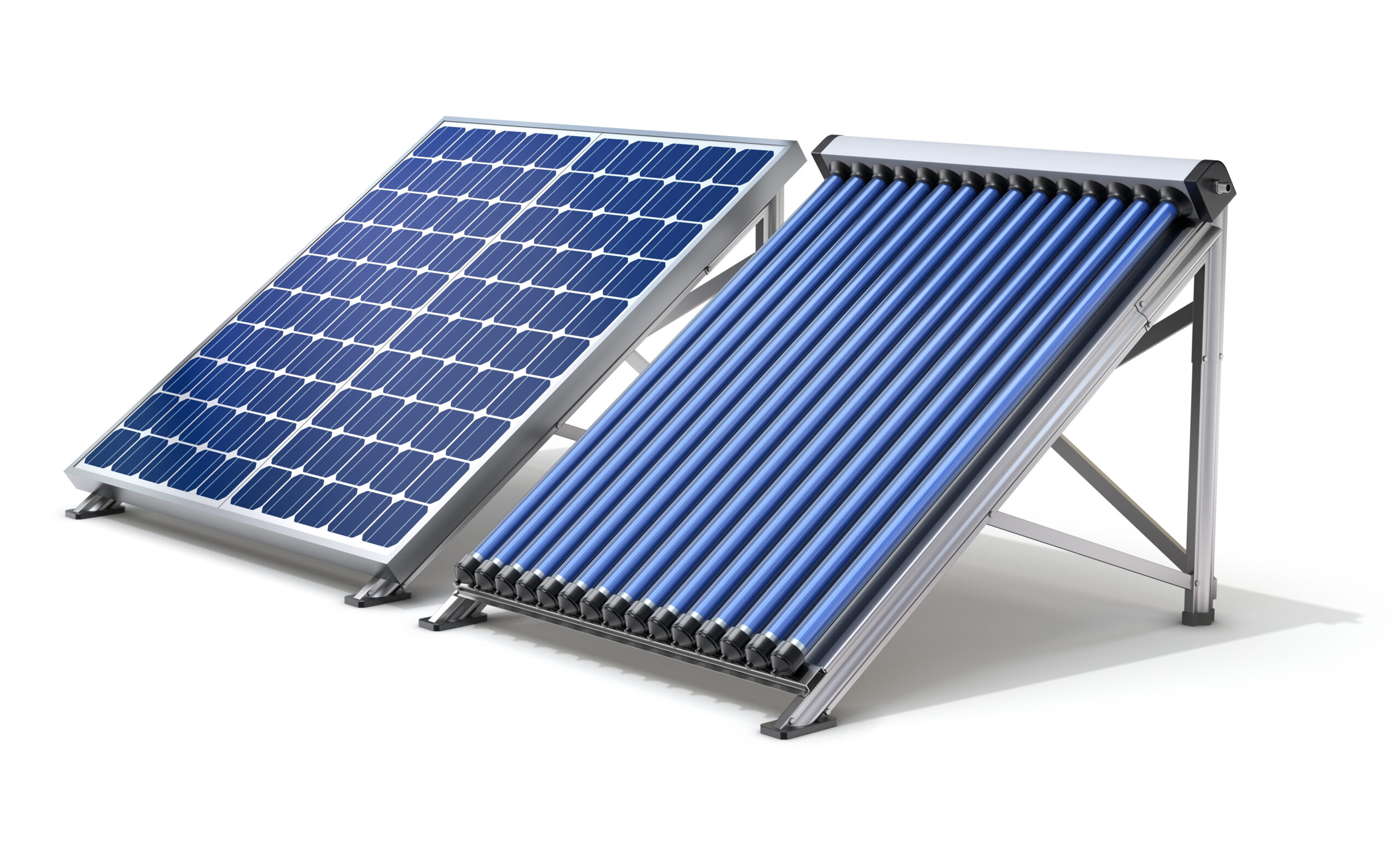
The two most common technologies available are the evacuated tube and the flat-panel system.
The evacuated tube system relies on two tubes in which the space between them has been evacuated of air, to minimise heat loss. The inner tube houses a copper rod, and is called the absorber, which has an aluminium fin attached to the bottom end. Solar radiation strikes the rods as luminosity, turning into heat within the inner tube. The copper rod is an excellent thermal absorber and absorbs the incoming light and converting this into heat efficiently. As the rod heats up the energy travels towards the upper end where a manifold filled with a liquid lies which also heats up. A heat exchanger transfers the hear from the liquid inside the manifold to the water that is ultimately going to be used domestically.
A flat-plate collector consists of a large heat absorbing plate and has copper piping running length wise across the plate. As the solar radiation strikes the surface of the plate, the absorbing plate heats up, and transfers the heat to the copper piping. This system can come in two different varieties: direct solar thermal or indirect solar thermal. Direct solar thermal heats the water that will be used directly and flows around the panel from one end of the geyser to another. The phenomena called thermosyphoning helps move the water in a loop, from cold to hot. The indirect method employs a heat exchanger and uses a glycol mix within the panel. The glycol mix moves into a coil heat exchanger once warmed, and subsequently transfers the heat to the water that will be used.
Both technologies are, once installed, easy to maintain and have an operating life span of more than ten years.
What are the savings like?
Real savings depends on several factors such as weather, climate, and latitudes. However, in moderate conditions one can expect to save up 70% on their water heating bill, or roughly 40% of their total household electricity consumption. On average the payback period of a solar hot water system in South Africa is 5.5 years.
No responses yet